
OTS article featured in Engineering Maintenance Solutions
We’re pleased to share that Engineering Maintenance Solutions has published an OTS Group article in its August/September 2026 issue. Beyond Visual Inspection: A Tiered Approach to Fuel Tank Integrity Testing explains why visual checks can’t give asset owners the full picture of a tank’s condition, and how a staged programme of Non-Destructive Testing (NDT) fills the gap.
Beyond visual inspection: a tiered approach to fuel tank integrity testing
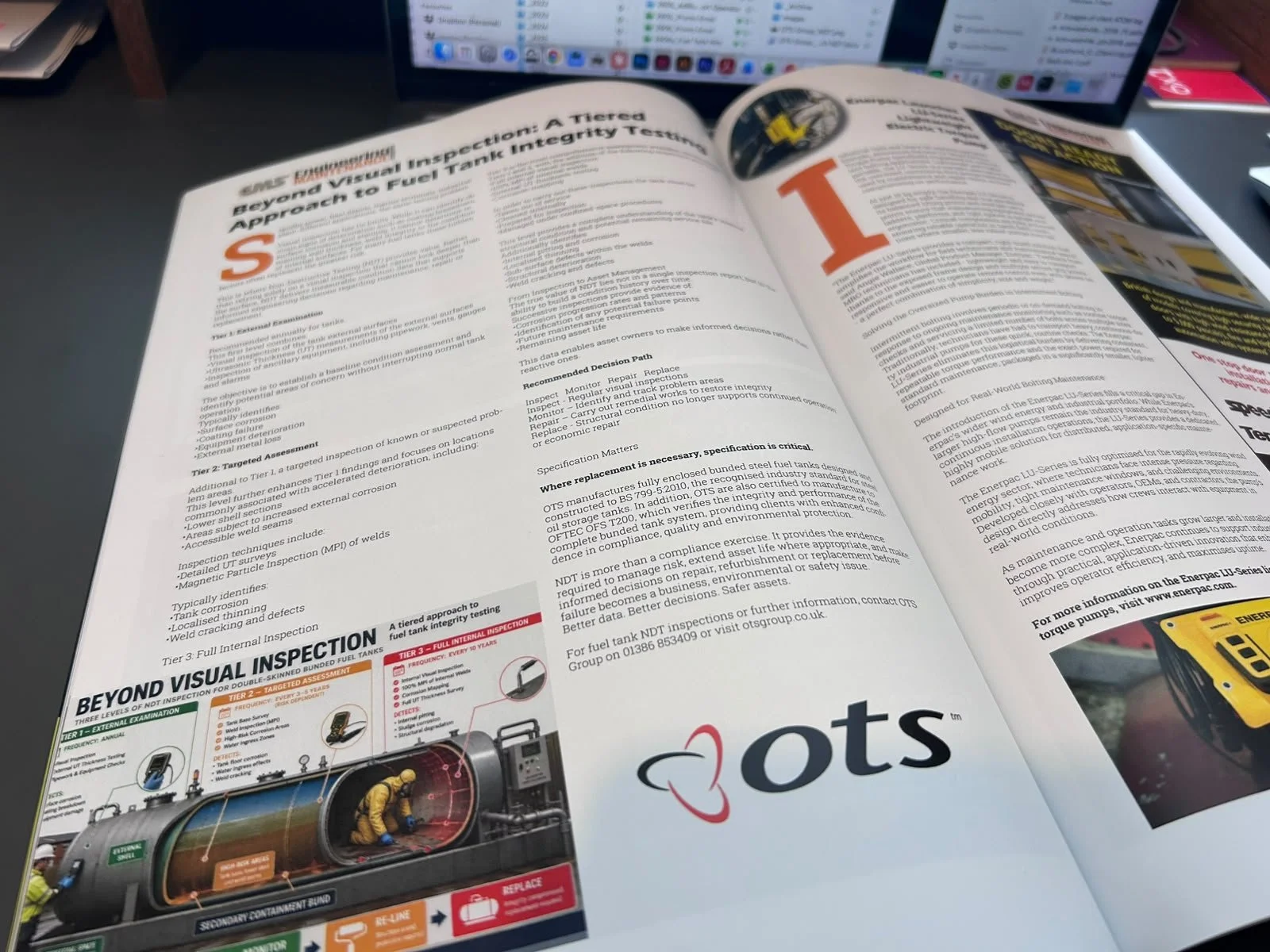
Visual inspection can identify coating breakdown, surface corrosion and staining, but it can’t determine remaining wall thickness, weld integrity or the condition of internal surfaces. For many fuel tanks, those hidden factors carry the greatest risk. NDT gives asset owners measurable condition data to support engineering decisions on maintenance, repair or replacement.
The article sets out three levels of inspection:
Tier 1, external examination: recommended annually, combining a visual inspection of external surfaces with Ultrasonic Thickness (UT) measurements and a check of ancillary equipment, including pipework, vents, gauges and alarms. It establishes a baseline condition assessment without interrupting normal tank operation.
Tier 2, targeted assessment: a detailed inspection of known or suspected problem areas, such as lower shell sections, areas of increased external corrosion and accessible weld seams. Detailed UT surveys and Magnetic Particle Inspection (MPI) of welds help identify tank corrosion, localised thinning, and weld cracking and defects.
Tier 3, full internal inspection: the most comprehensive assessment available. It includes Tiers 1 and 2, with the addition of a full internal visual inspection, 100% MPI of internal welds, internal UT thickness testing and corrosion mapping. The tank needs to be taken out of service, cleaned internally, prepared for inspection and managed under confined-space procedures.
From inspection to asset management
The article also makes the case that the value of NDT lies in the ability to build a condition history over time, not in a single inspection report. Successive inspections give evidence of corrosion progression rates and patterns, potential failure points, future maintenance needs and remaining asset life. That lets asset owners make informed decisions rather than reactive ones, following a clear decision path: inspect, monitor, repair or replace.
Specification matters
Where replacement is necessary, specification is critical. OTS manufactures fully enclosed bunded steel fuel tanks designed and constructed to BS 799-5:2010, the recognised industry standard for steel oil storage tanks. OTS is also certified to manufacture to OFTEC OFS T200, which verifies the integrity and performance of the complete bunded tank system.
We’re proud to see our engineering knowledge shared with the maintenance community. As the article puts it, NDT is more than a compliance exercise: it provides the evidence needed to manage risk, extend asset life where appropriate, and make informed decisions on repair, refurbishment or replacement before failure becomes a business, environmental or safety issue. Better data. Better decisions. Safer assets.