Meet Mike G: An engineer’s approach to technical sales at OTS Group
When Mike joined OTS in early January, it marked the start of a new role designed to strengthen something the business already values highly: engineering-led thinking at the very front of the customer conversation.
With a background rooted firmly in safety-critical engineering and project delivery, Mike brings a perspective that fits naturally with how OTS operates. His role, Technical Sales Manager, is less about selling in the traditional sense and more about understanding challenges, shaping the right solution, and making sure what is proposed can be delivered properly.
From safety-critical engineering to problem-solving conversations
Mike began his career in the Royal Air Force, where he spent more than a decade as a mechanical engineer. After completing his technical training and early operational experience, he went on to work extensively on both Eurofighter Typhoon and C-17 Globemaster aircraft. It was an environment where accuracy, accountability, and reliability were non-negotiable.
Following his time in the RAF, Mike moved into industrial engineering roles across service, applications, and project delivery. His work included supporting complex systems and specialising in the decarbonisation of industrial boilers, where he acted as a subject matter expert and took responsibility for ensuring solutions were technically sound and deliverable in practice.
That delivery-first mindset is central to how Mike approaches his role at OTS.
“I’ve always worked in roles where you’re accountable for what happens after the decision is made,” he explains. “That naturally shapes how you think when you’re discussing solutions with customers.”
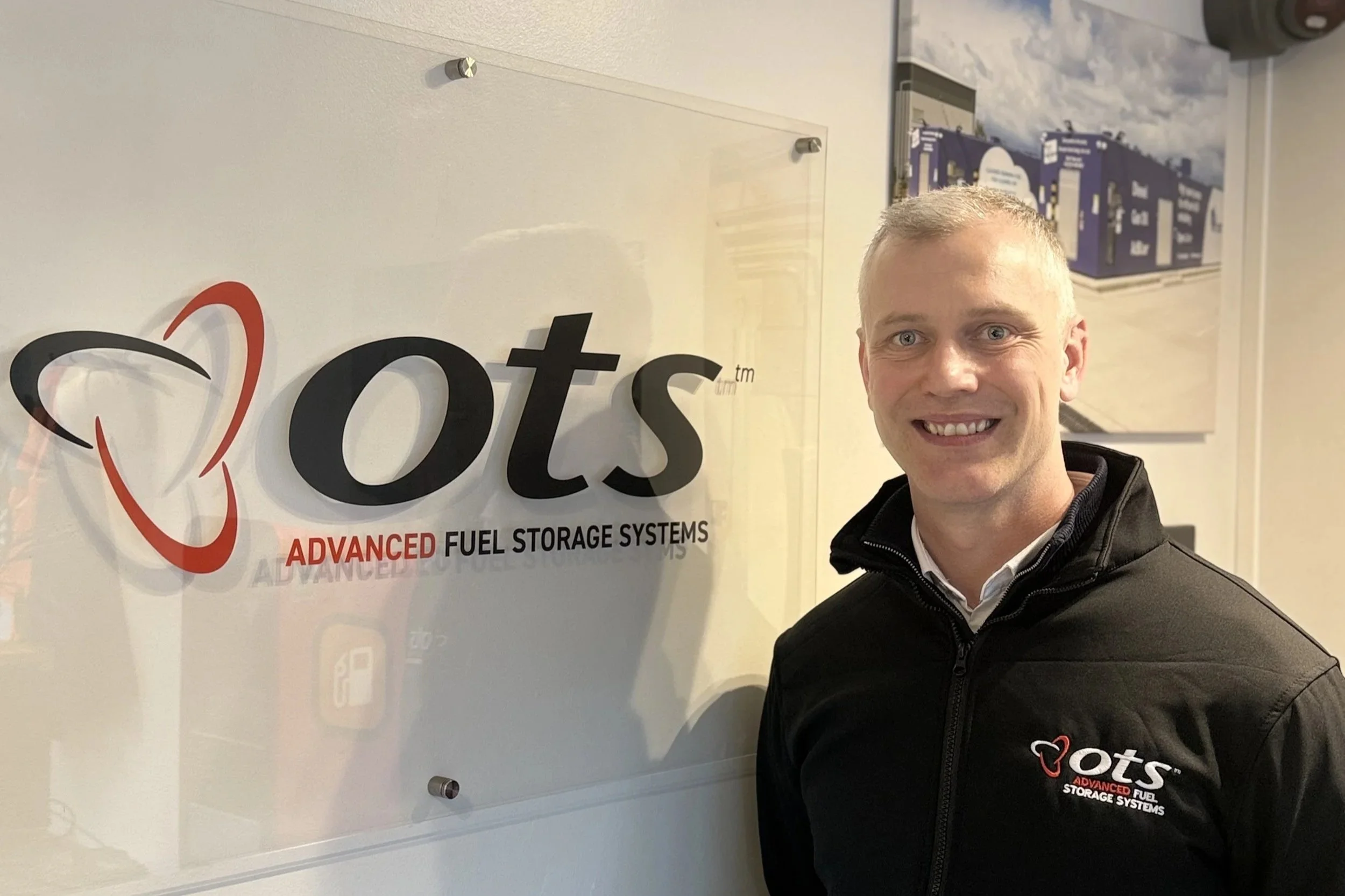
Mike
Engineering-led sales at OTS
At OTS, sales conversations are rarely about products in isolation. They are about understanding site constraints, operational demands, compliance requirements, and long-term performance.
Mike’s role is designed to bring deeper engineering understanding into those early discussions. Rather than passing technical questions further down the line, he works to ensure that proposals are informed, realistic, and grounded in how systems will actually be built, installed, and supported.
His focus sits primarily within the manufacturing and installation areas of the business. This includes developing a detailed understanding of manufactured tank systems, slab tanks, associated calculations, ancillary equipment, and the practical realities of working on industrial sites.
The aim is not speed for its own sake, but confidence. Confidence that solutions are technically robust, appropriately specified, and aligned with how OTS operates across its core disciplines.
Getting it right first time
One of the aspects of OTS that stood out to Mike early on is the company’s approach to service and delivery.
Rather than making broad promises around response times, the focus is on preparation and effectiveness. The priority is ensuring that when teams attend site, they are equipped with the right information, equipment and understanding to resolve issues properly.
“You can respond quickly,” Mike says, “but if you haven’t thought it through, you end up coming back. OTS places real value on turning up ready to fix the problem, not just inspect it.”
This approach reflects a wider pride in workmanship across the business. It is about reducing disruption for clients, avoiding repeat visits, and taking responsibility for outcomes, not just actions.
For someone who has spent much of their career in environments where mistakes carry serious consequences, that philosophy feels both familiar and necessary.
Protecting early-stage technical rigour as capacity grows
Early-stage technical input has always been part of how OTS operates. Detailed conversations around calculations, installation constraints, access limitations, compliance requirements, and long-term serviceability are not an afterthought. They sit at the front of the process.
As demand across manufacturing, installation, service, and environmental work increases, the priority has been to protect that approach rather than dilute it. Expanding engineering capacity within the commercial function ensures that technical scrutiny remains where it belongs, at the beginning of the conversation.
For clients operating critical fuel infrastructure, that matters. Decisions made at specification stage influence installation efficiency, long-term maintenance access, compliance exposure, and total lifecycle cost.
Mike’s role reinforces that discipline.
“If you resolve the technical detail early, you remove uncertainty later,” he explains. “You’re not redesigning mid-project. You’re not discovering constraints on site that could have been identified at the start.”
By strengthening engineering presence at the front end, OTS ensures that the same depth of thinking continues as workloads increase. It is not a change in philosophy, but a reinforcement of it.
Looking ahead
Still early in his time at OTS, Mike sees the opportunity clearly: to contribute to conversations that are grounded in delivery reality, not assumptions.
“It’s about understanding how something will actually be built, installed, and maintained,” he says. “If you know that, you can give a confident answer.”
As OTS continues to support complex fuel storage and handling projects, early technical rigour remains central. Growth is not about speed for its own sake. It is about expanding capability while maintaining the precision and accountability that define every OTS project.